K8Studio: Kubernetes Object Topology
Object Topology gives every Kubernetes resource a relationship diagram. Open a Pod, Deployment, Service, ConfigMap, Secret, PVC, or Node and see the objects connected to it without jumping through multiple describe commands.
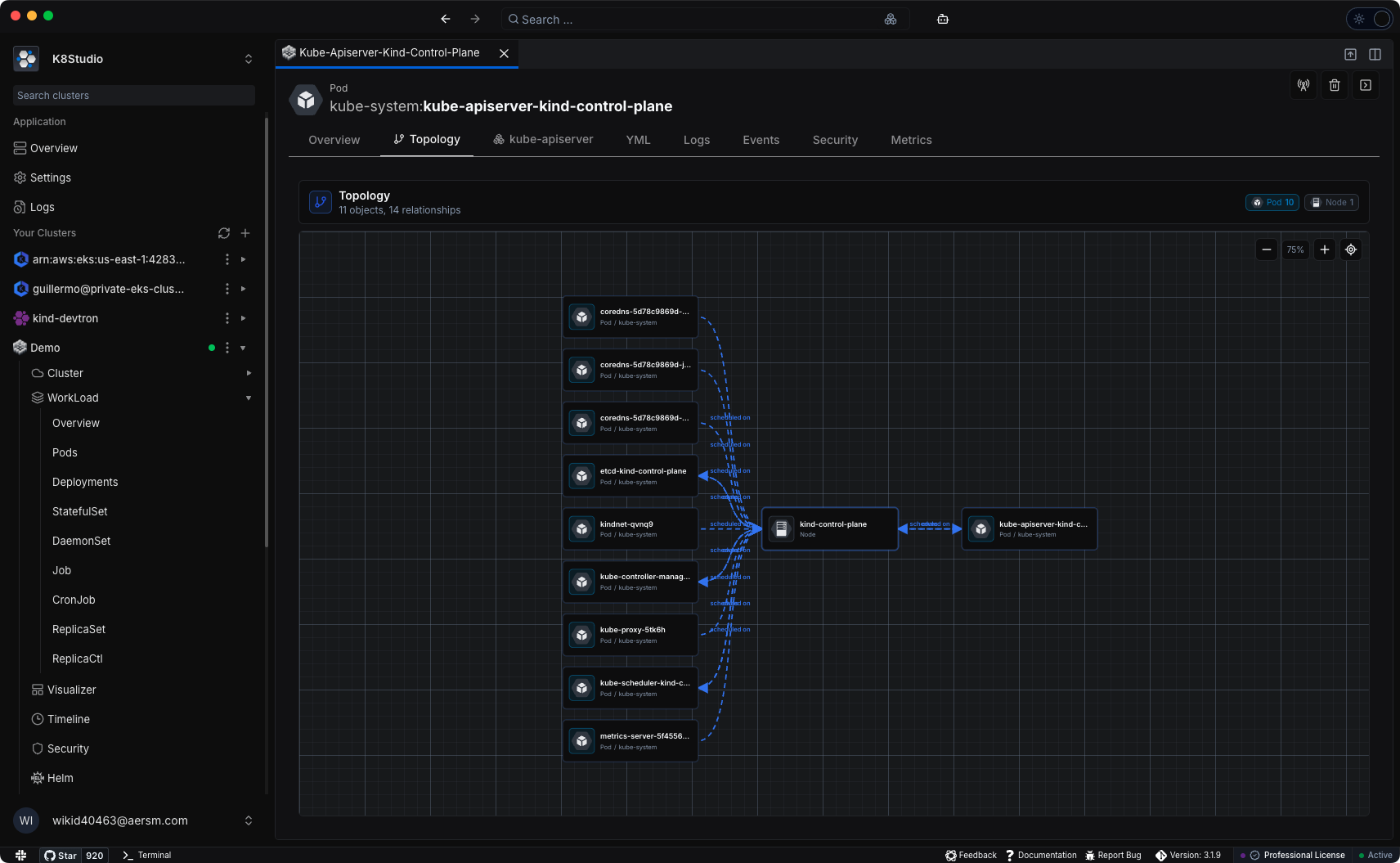
Kubernetes is built on relationships. Deployments manage ReplicaSets. ReplicaSets own Pods. Pods reference ConfigMaps, Secrets, PVCs, ServiceAccounts, and Nodes. Services select Pods. Ingresses route to Services. When you are debugging or planning a change, those relationships matter.
What Object Topology shows
- Connected resources: See the selected object and the Kubernetes resources related to it in one focused diagram.
- Ownership paths: Follow controller relationships such as Deployment to ReplicaSet to Pod.
- Runtime dependencies: Spot objects a workload depends on, including ConfigMaps, Secrets, PVCs, Nodes, and Services.
- Directional relationships: Arrows show how resources connect, so selectors, ownership, scheduling, and dependency paths are easier to follow.
- Focused graph expansion: Shared objects stay readable instead of exploding into every dependent object unless you inspect them directly.
- Pan and zoom navigation: Move around the diagram, zoom in, and center the view when investigating larger object graphs.
When to use it
- Before changing a ConfigMap or Secret, check which workloads may be affected.
- During an incident, select a failing Pod and see the Services, Node, volumes, and configuration objects around it.
- During onboarding, show how a service is assembled without drawing the graph manually.
- During a security review, inspect which workloads are connected to sensitive resources.
A topology view for daily troubleshooting
Object Topology keeps dependency mapping inside the same K8Studio detail view you already use for Overview, YAML, Logs, Events, Security, and Metrics. It gives you the missing relationship context without requiring a separate diagramming tool or an in-cluster agent.