Erik McFarlaine
Kubernetes practitioner
I used to work with K9s, but the capabilities K8Studio provides are far superior. The multitab workflow, integrated terminal, and especially the logs change everything.
Explore, debug, and operate every cluster from one desktop workspace. Connect with kubeconfig. No agents, and your cluster data stays local by default.
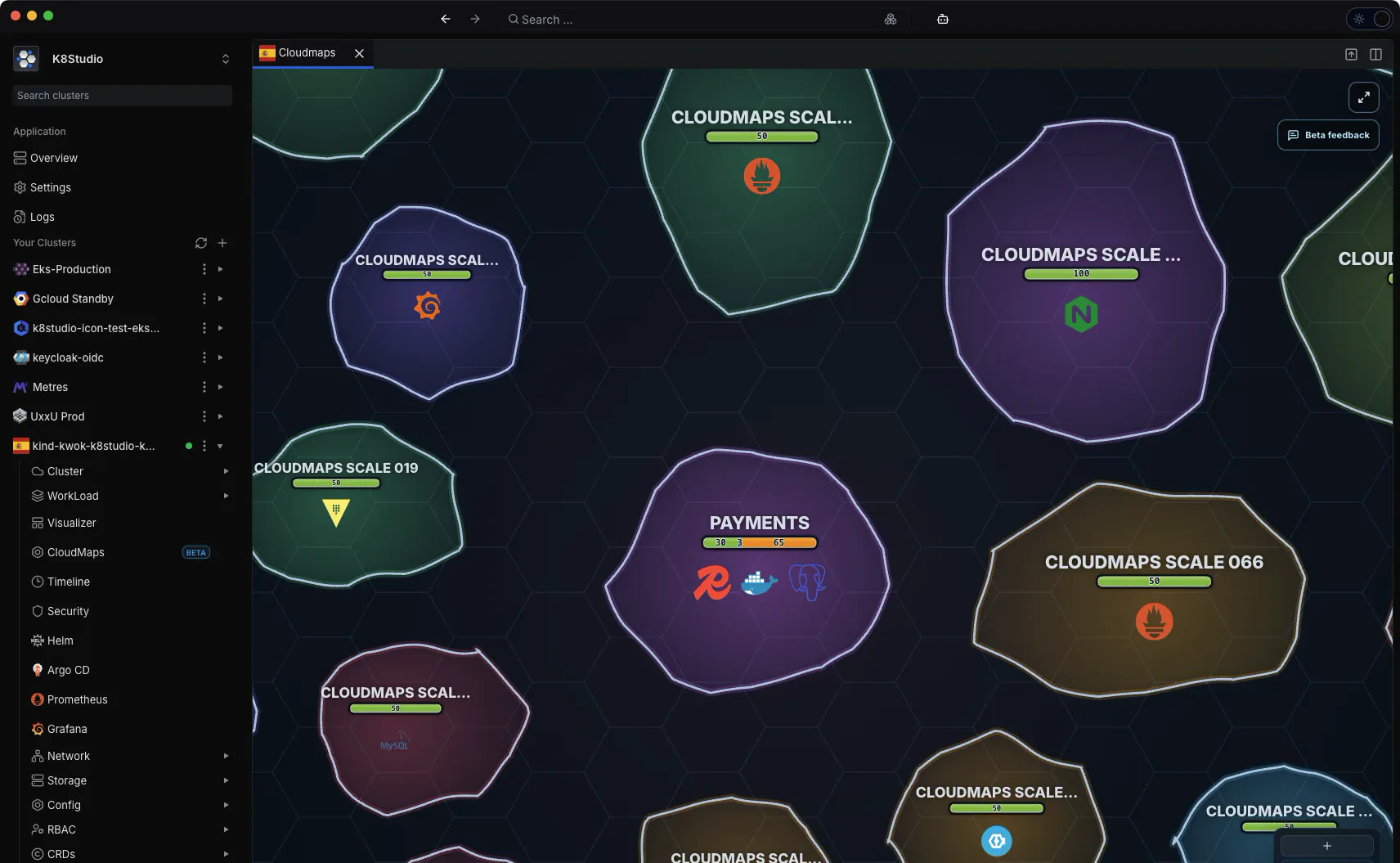
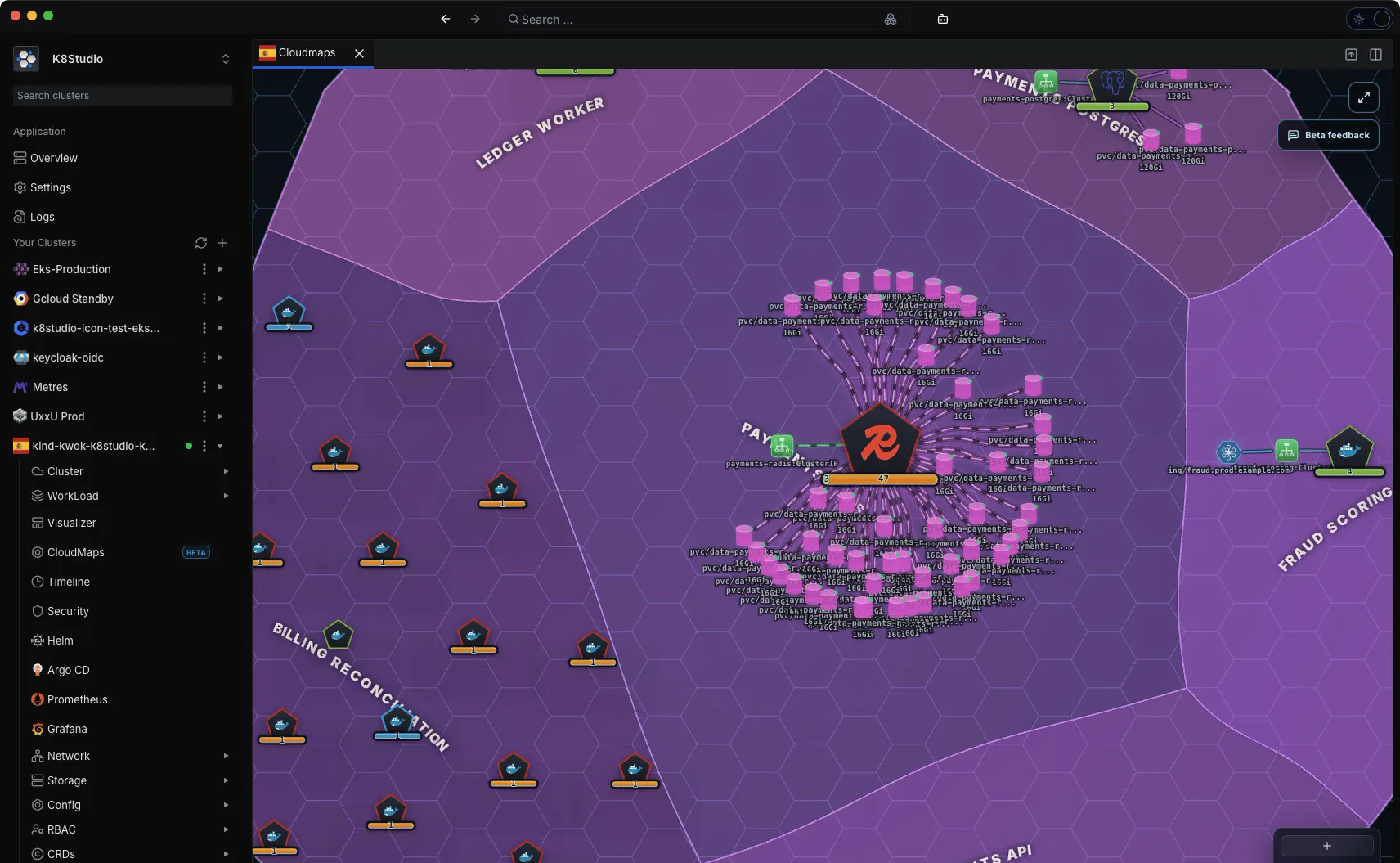
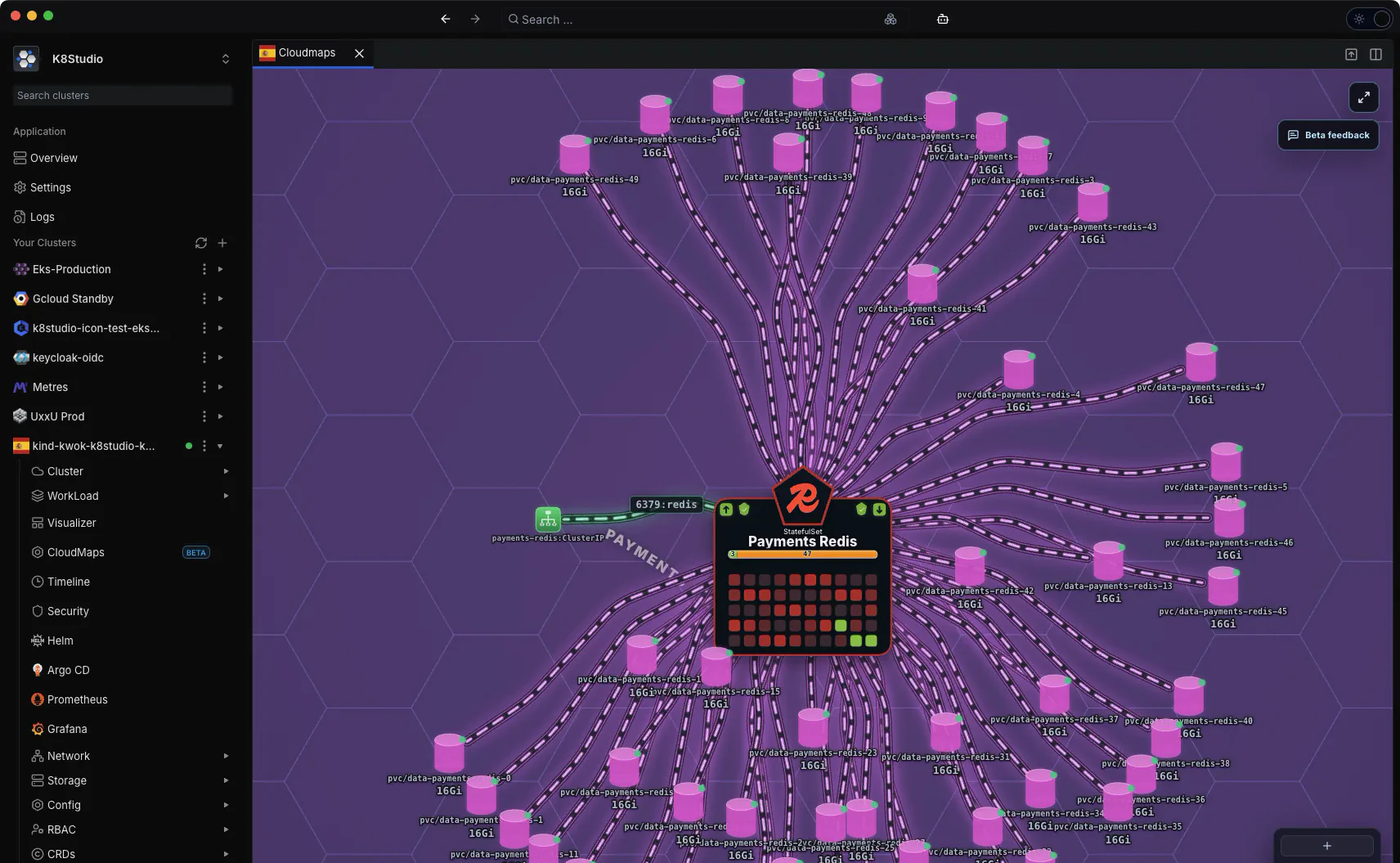
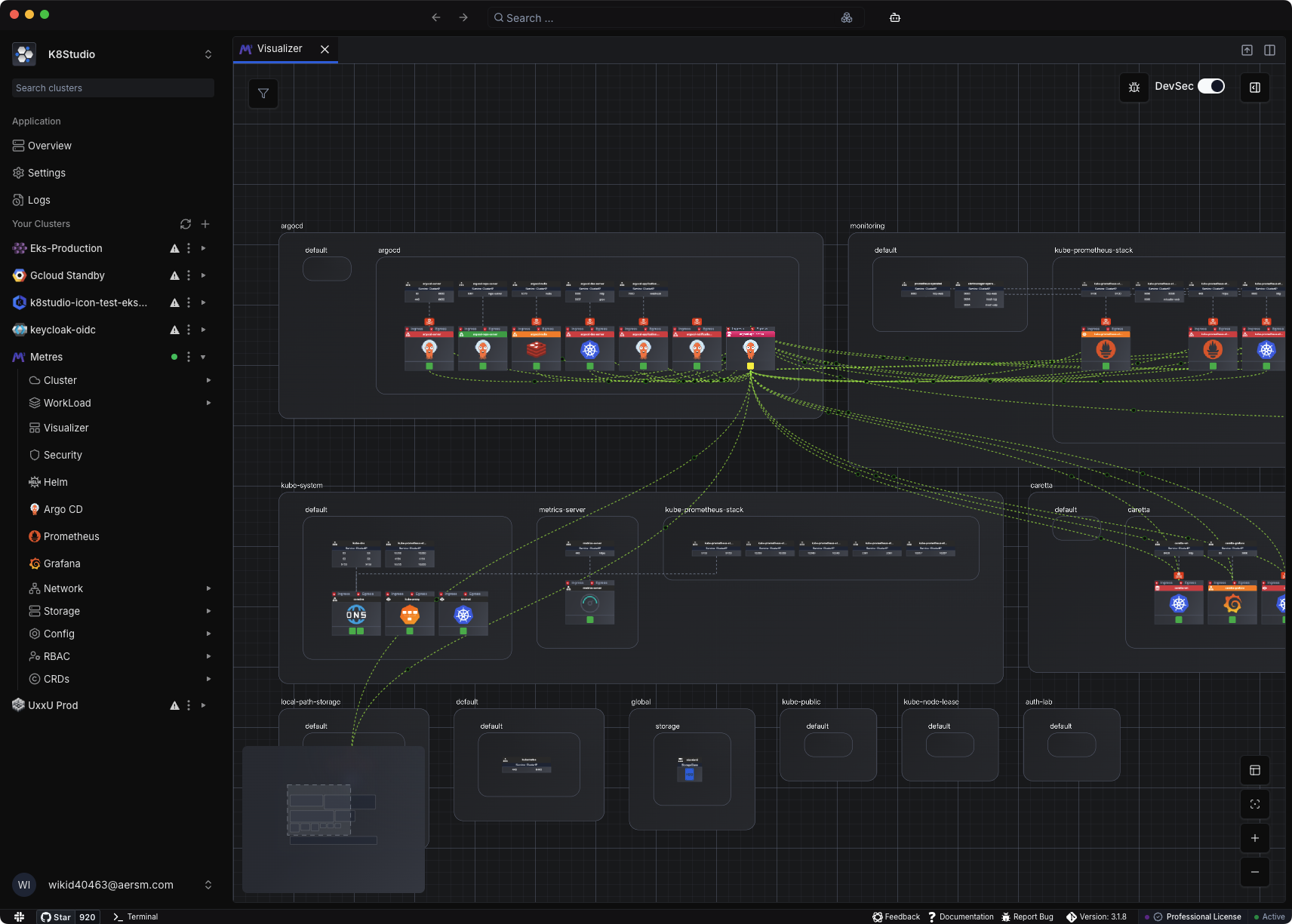
See everything, spot problems, understand your cluster in seconds. CloudMaps turns 5,000+ workloads into an explorable live map of namespaces, apps, storage, and dependencies.
Join the Discord to share feedback from real clusters, report rendering edge cases, and follow K8Studio 4.0.3 updates with the team.
Kubernetes practitioner
I used to work with K9s, but the capabilities K8Studio provides are far superior. The multitab workflow, integrated terminal, and especially the logs change everything.
AWS Architect at Cloudera
Best tool to manage Kubernetes in multicluster. The logging is the fastest I know and does not hang with big output. It is also the only one that has a built-in RBAC manager.

IT Consultant and Security Champion
K8Studio empowers me in a way kubectl just doesn't match. I get an easy overview, and it has already discovered security issues I didn't know we had. Talking with management is so much easier with K8Studio's visual view of pods and their namespaces.

Kubernetes educator
K8Studio has changed the way I can present and teach Kubernetes. It gives people a much clearer view of what is happening inside a cluster and saves a huge amount of time when upskilling teams. Being able to see the full environment visually, instead of manually piecing everything together with CLI commands, makes Kubernetes security and troubleshooting far more accessible.

Senior Technical Director @TSYS
K8Studio has simplified Kubernetes management for our team, improving productivity for both developers and operations. The built-in terminal, real-time monitoring, and customizable alerts have enhanced efficiency and minimized disruptions. Shared project environments enable smooth collaboration and ensure consistency across deployments, making K8Studio an invaluable tool in our Kubernetes ecosystem.

Senior DevOps Engineer
K8Studio is the most underrated Kubernetes tool. It has everything: multicluster workflows, multitabs, and security network policy maps that are genuinely helpful. As a contractor, keeping everything in one place matters, and the visualizer helps me switch context quickly and understand each cluster faster.
Workspace and views
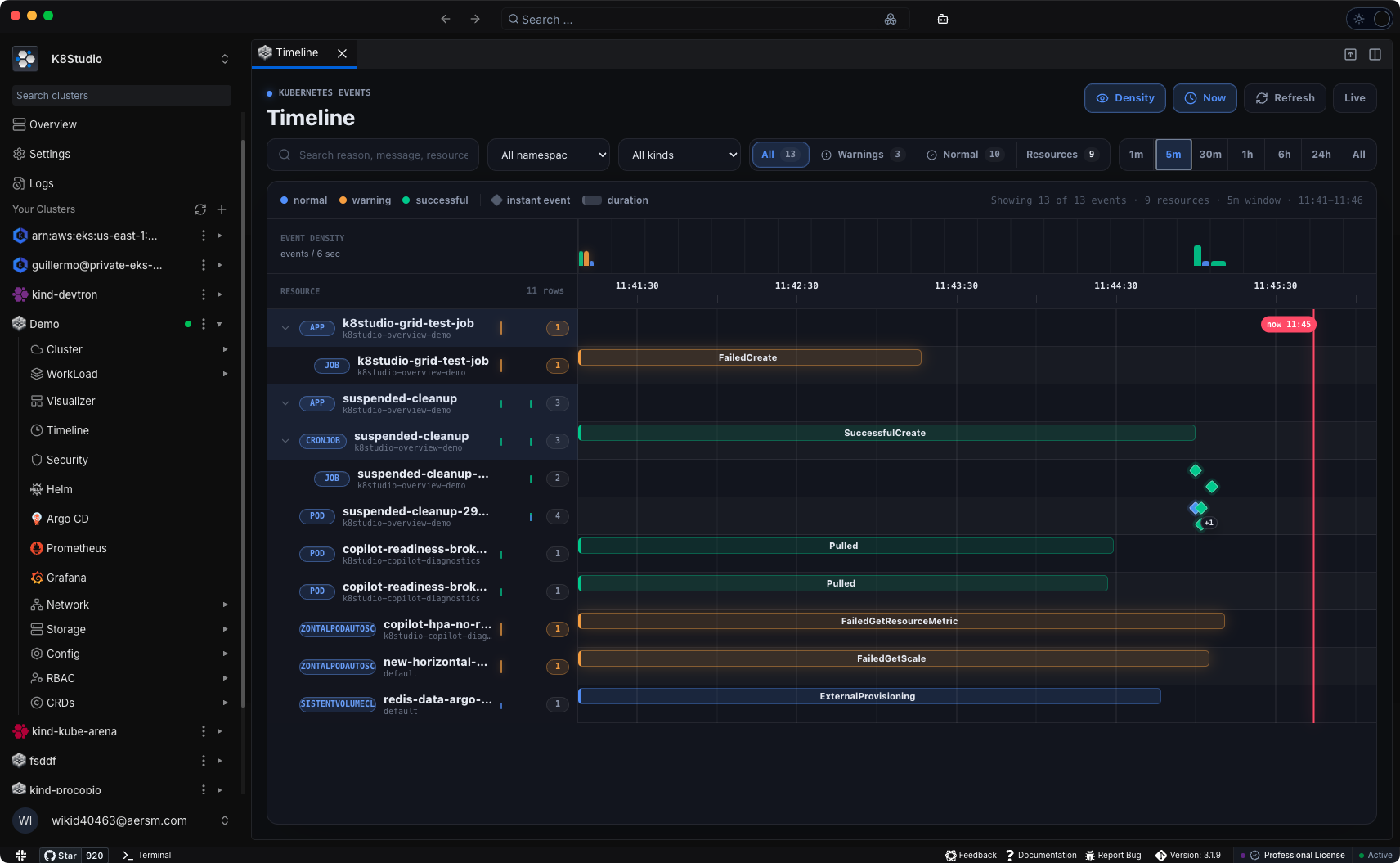
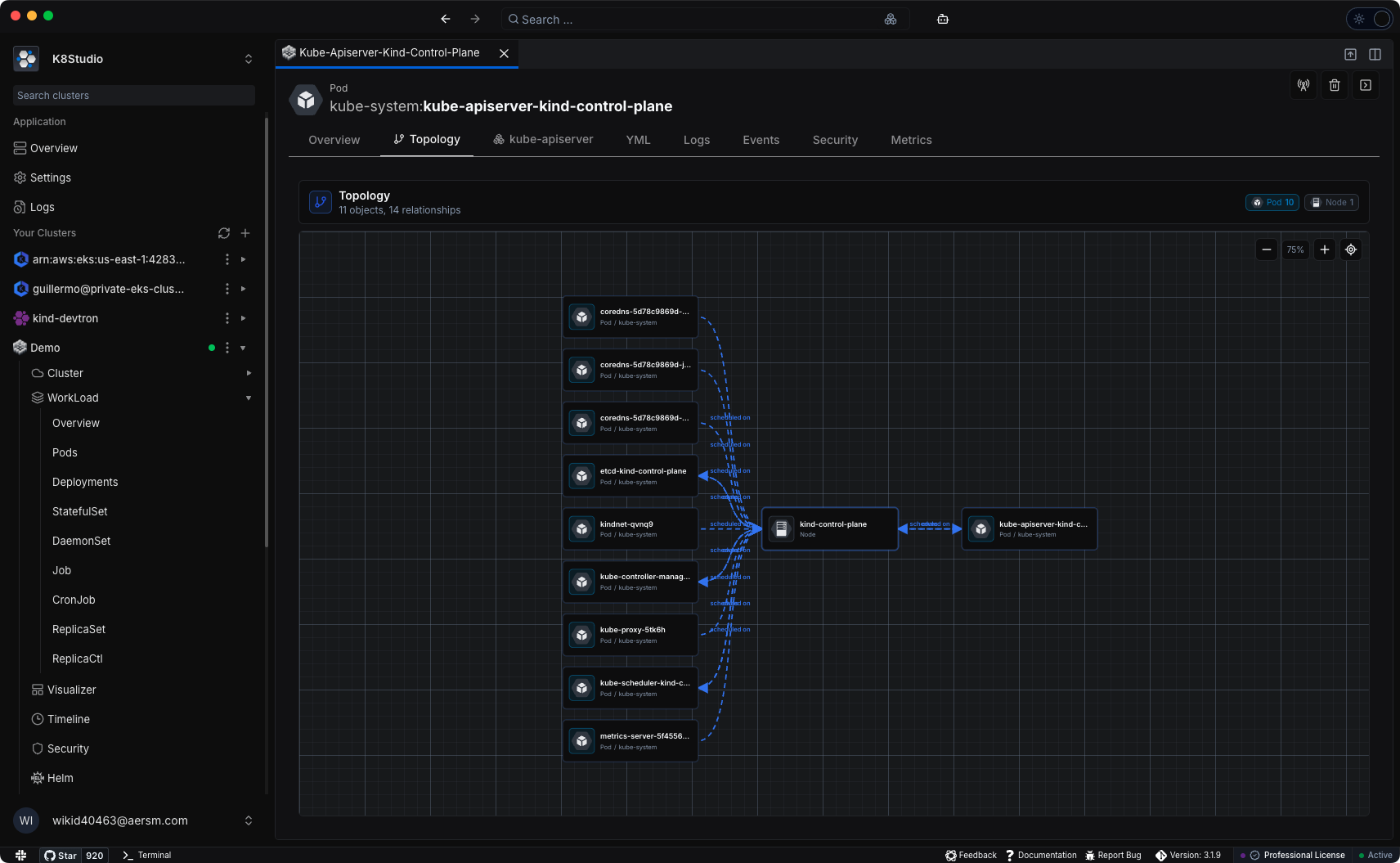
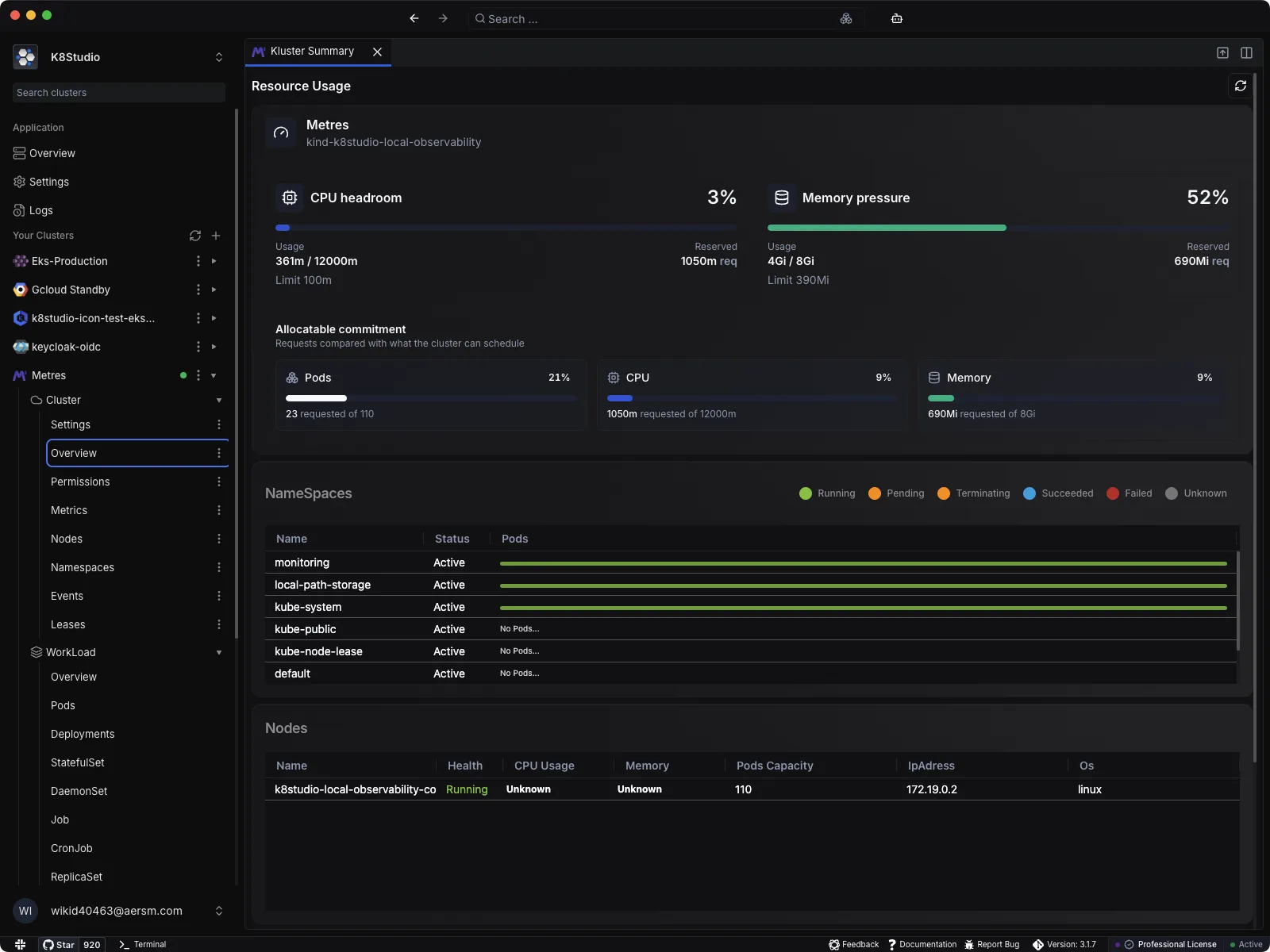
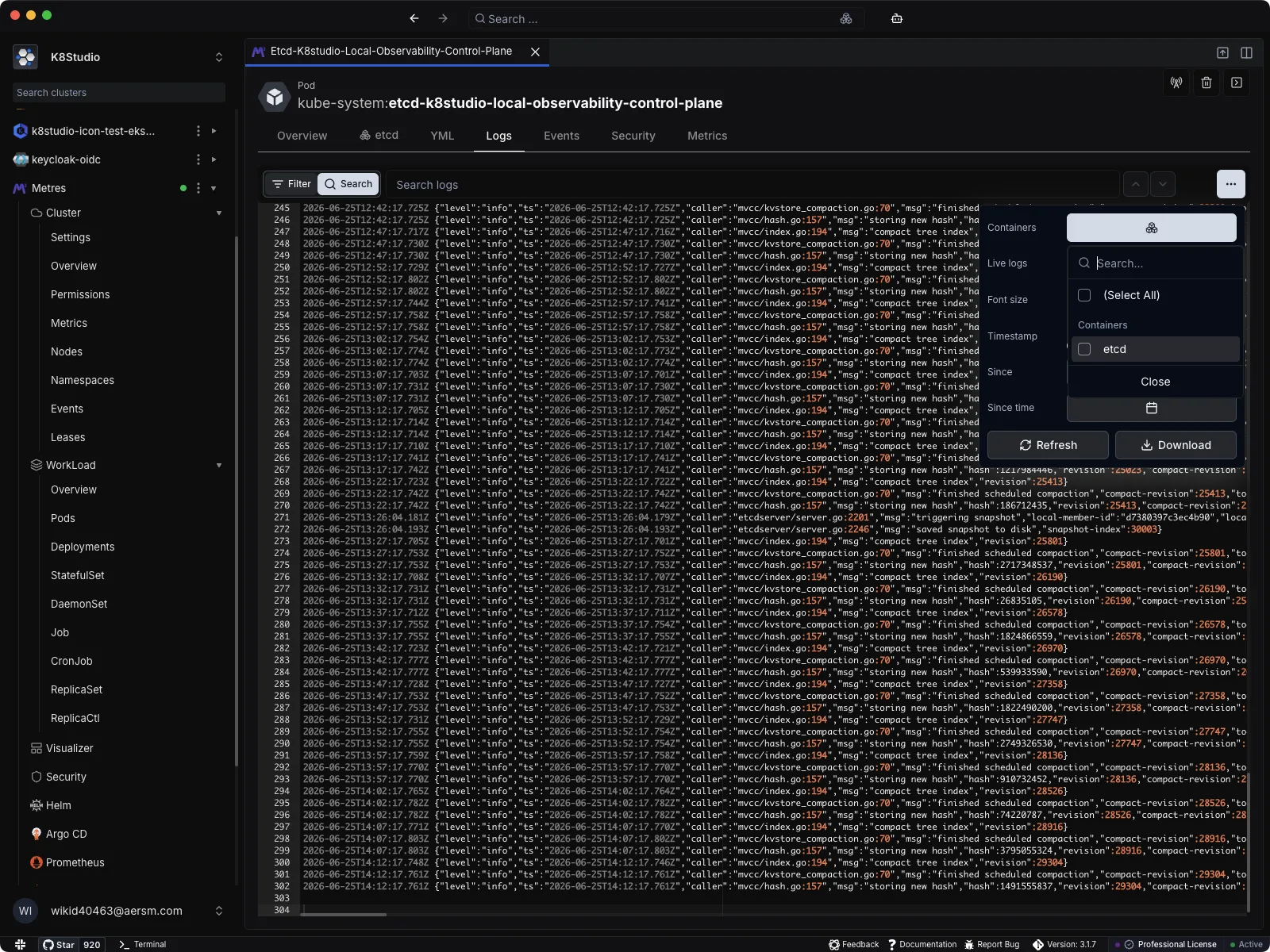
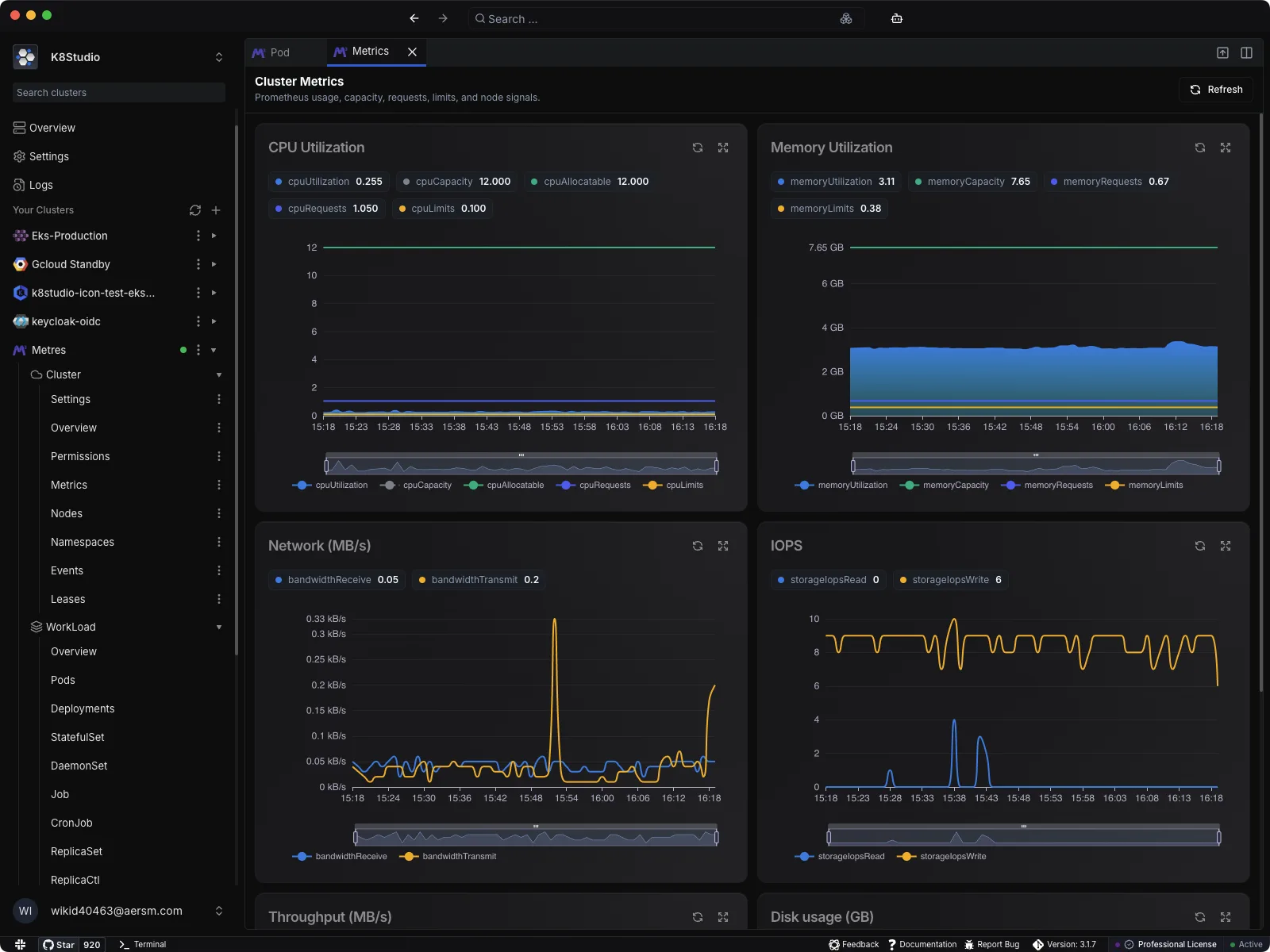
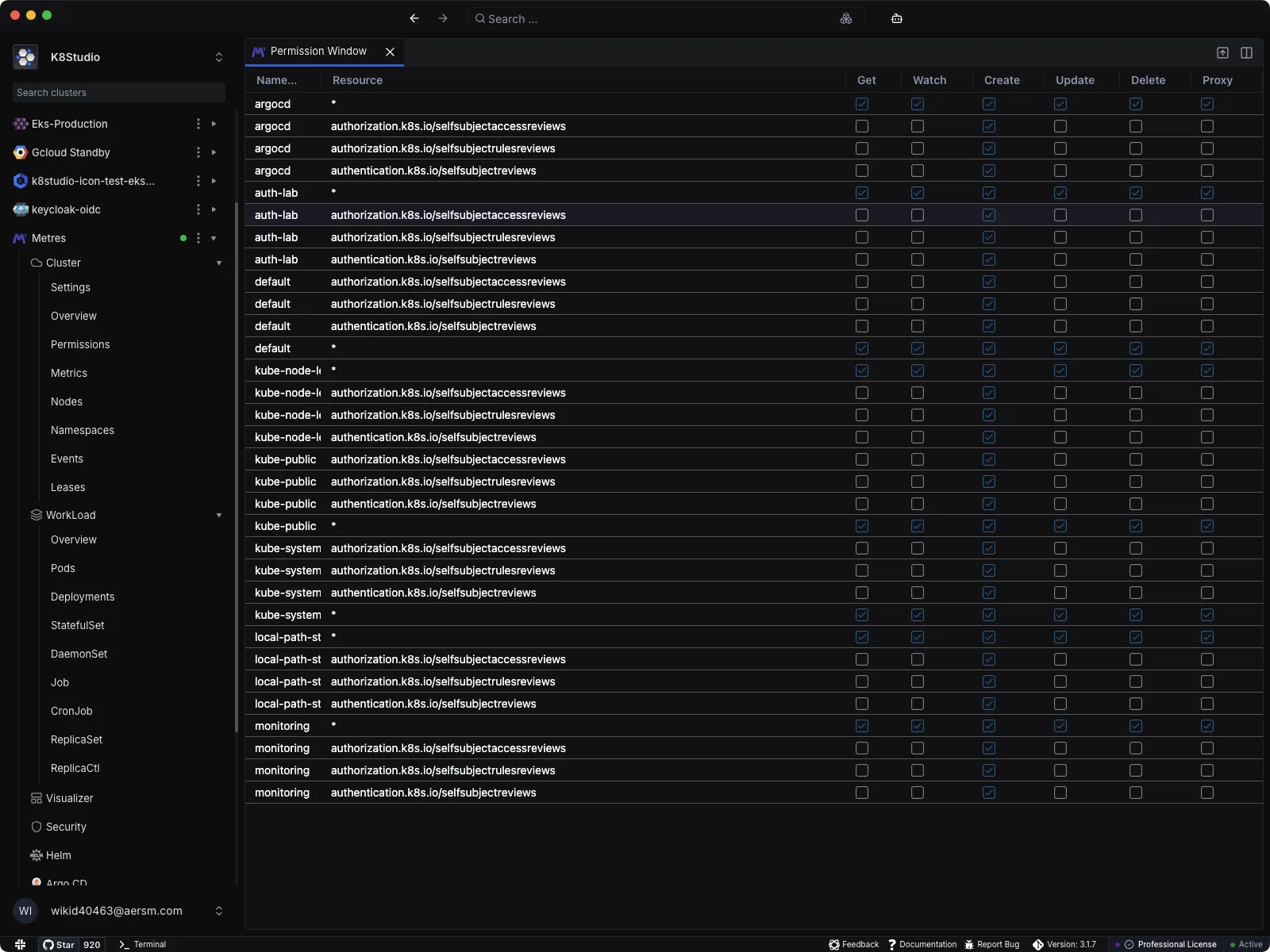
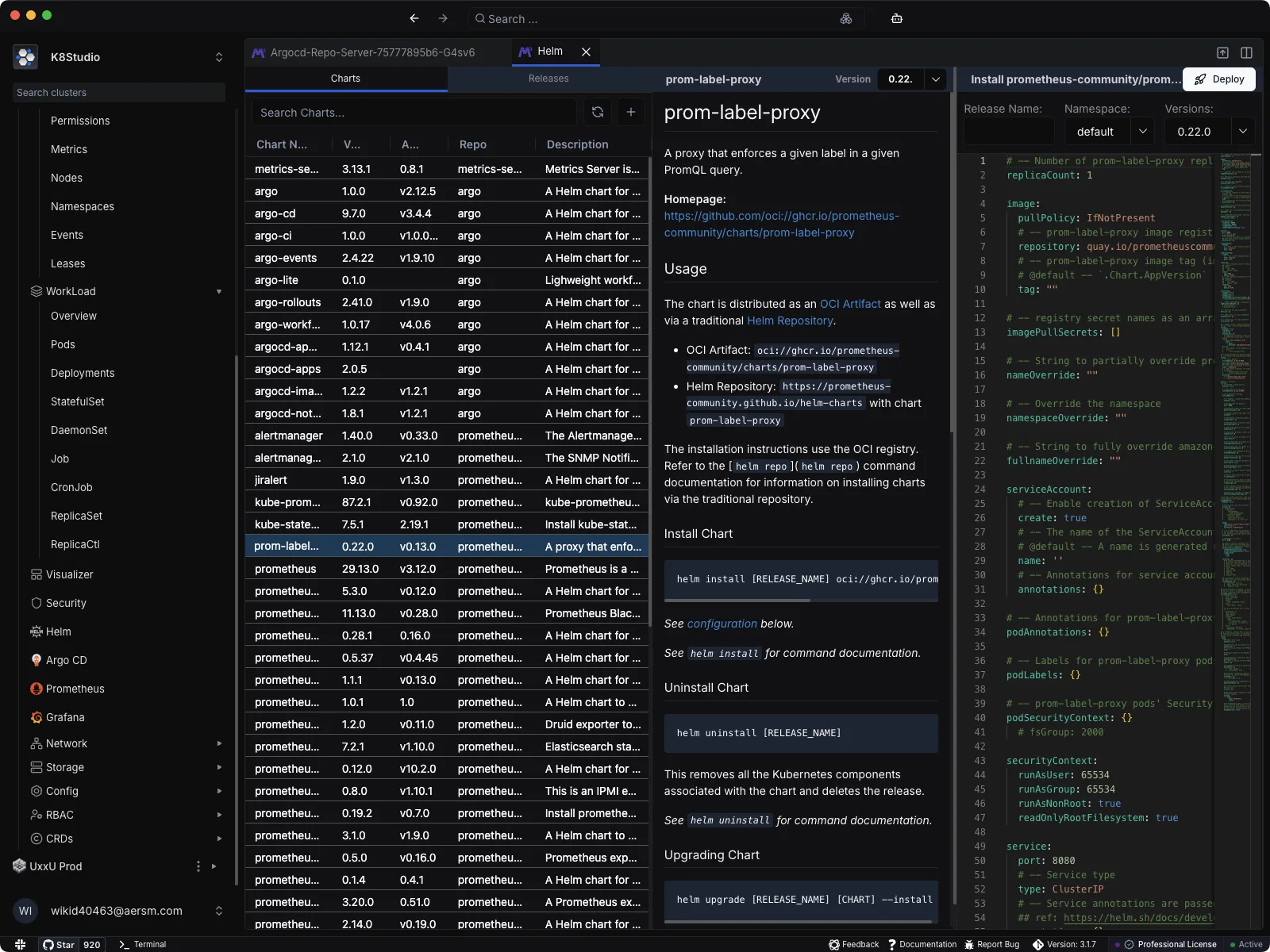
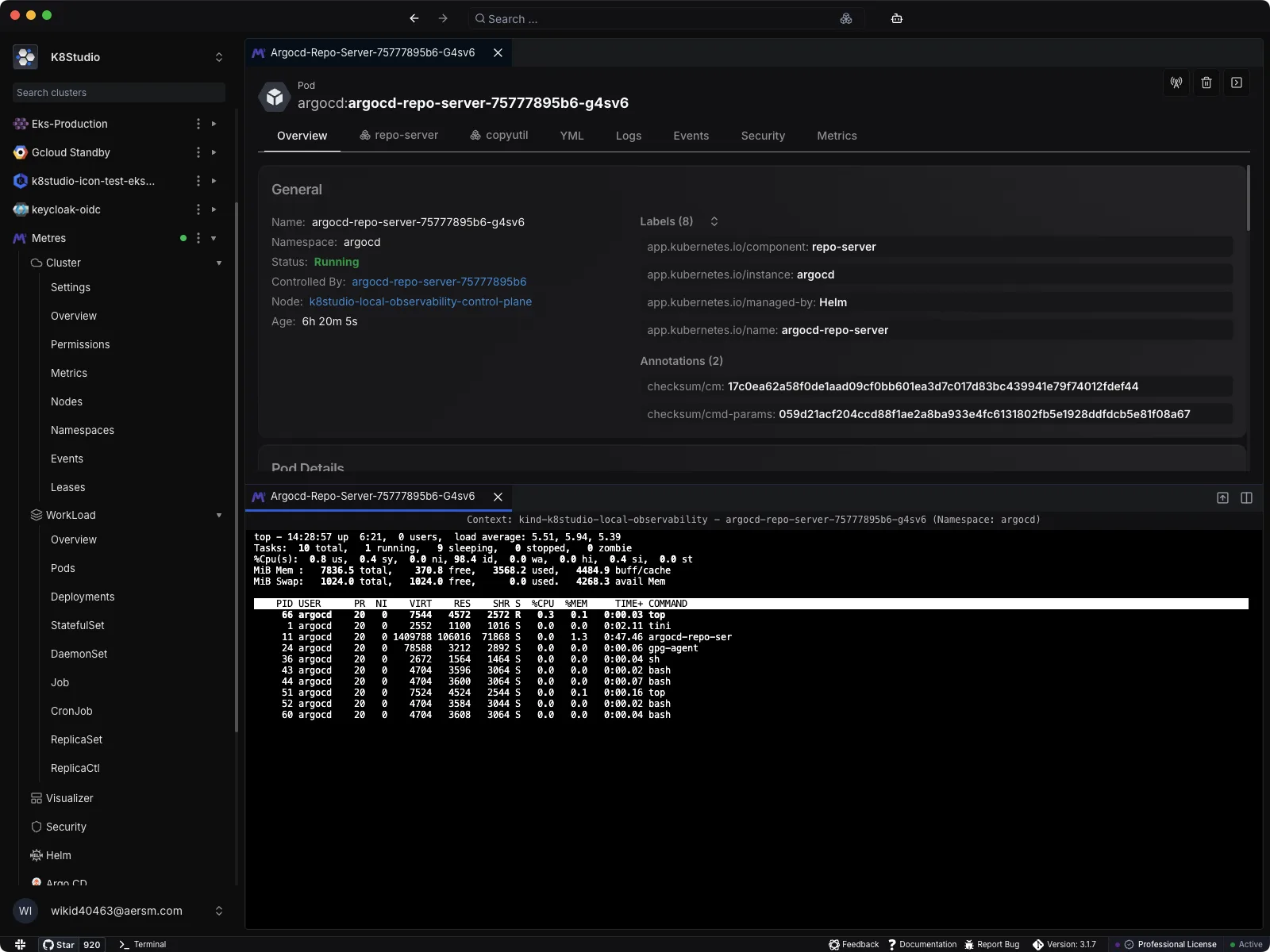
K8Studio keeps the important views docked together: grids, topology, timelines, logs, YAML, terminal, RBAC, Helm, and integrations. You can move from a cluster-wide question to a single object without rebuilding context in another tool.
Explore all views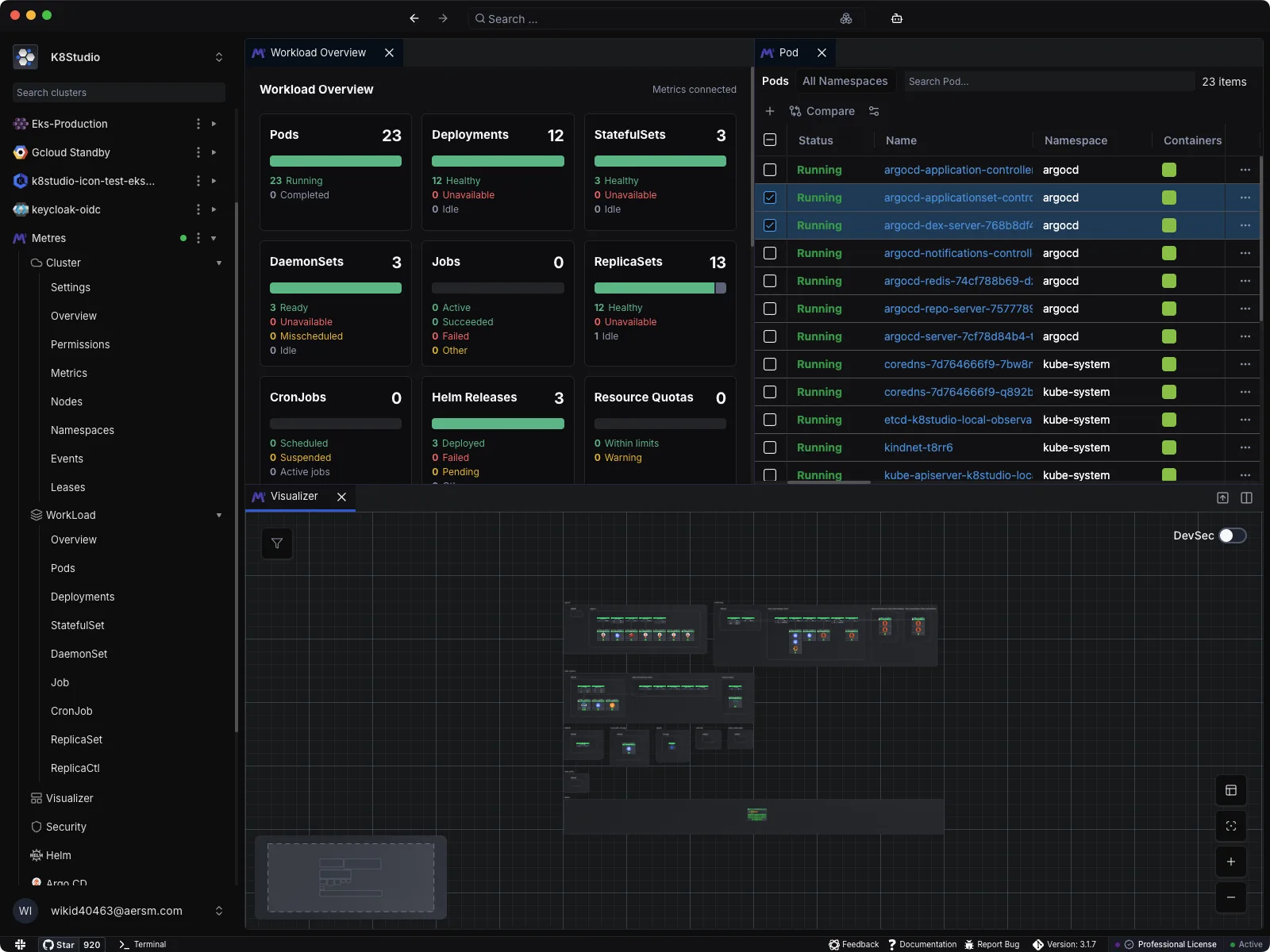
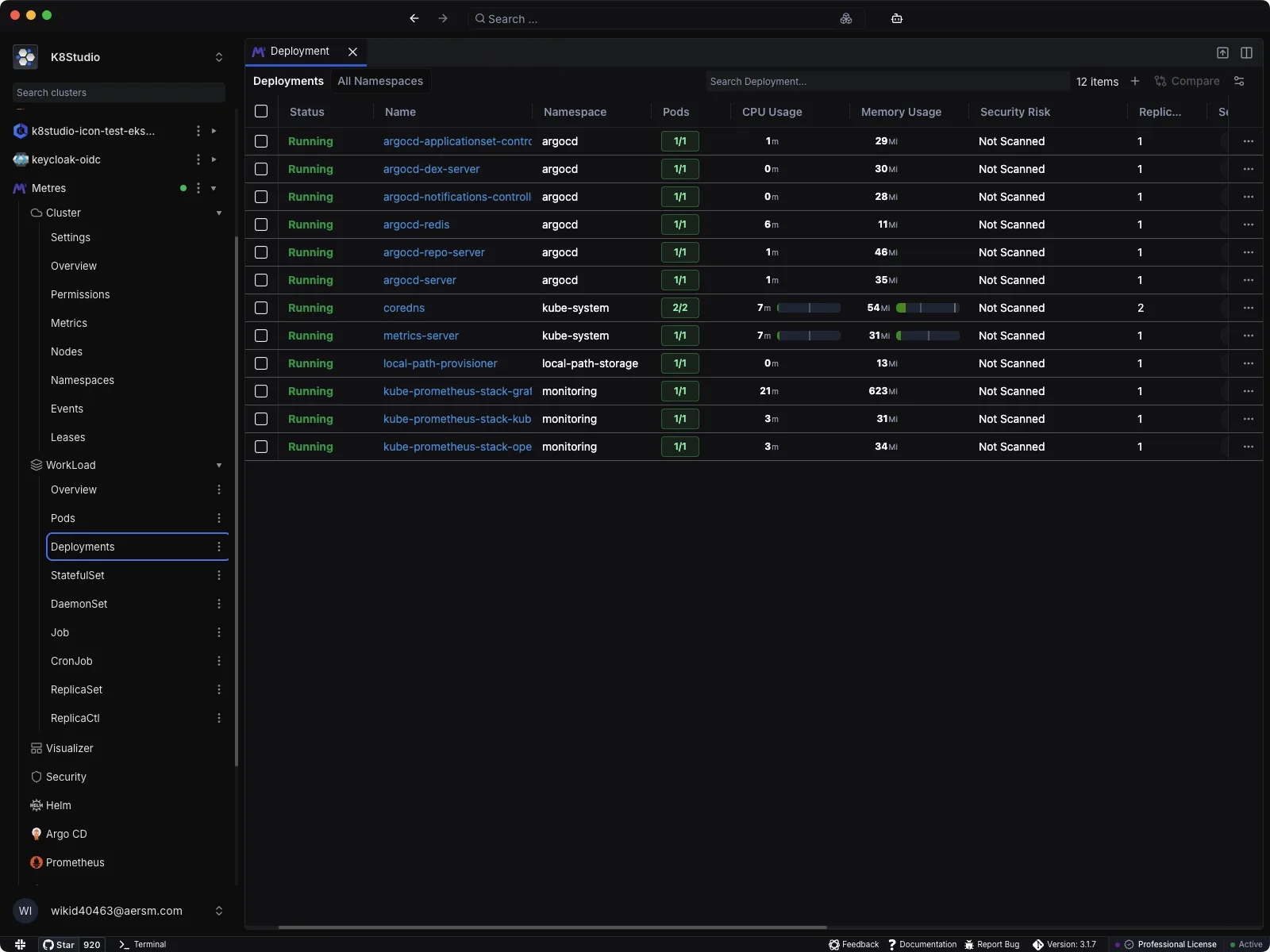
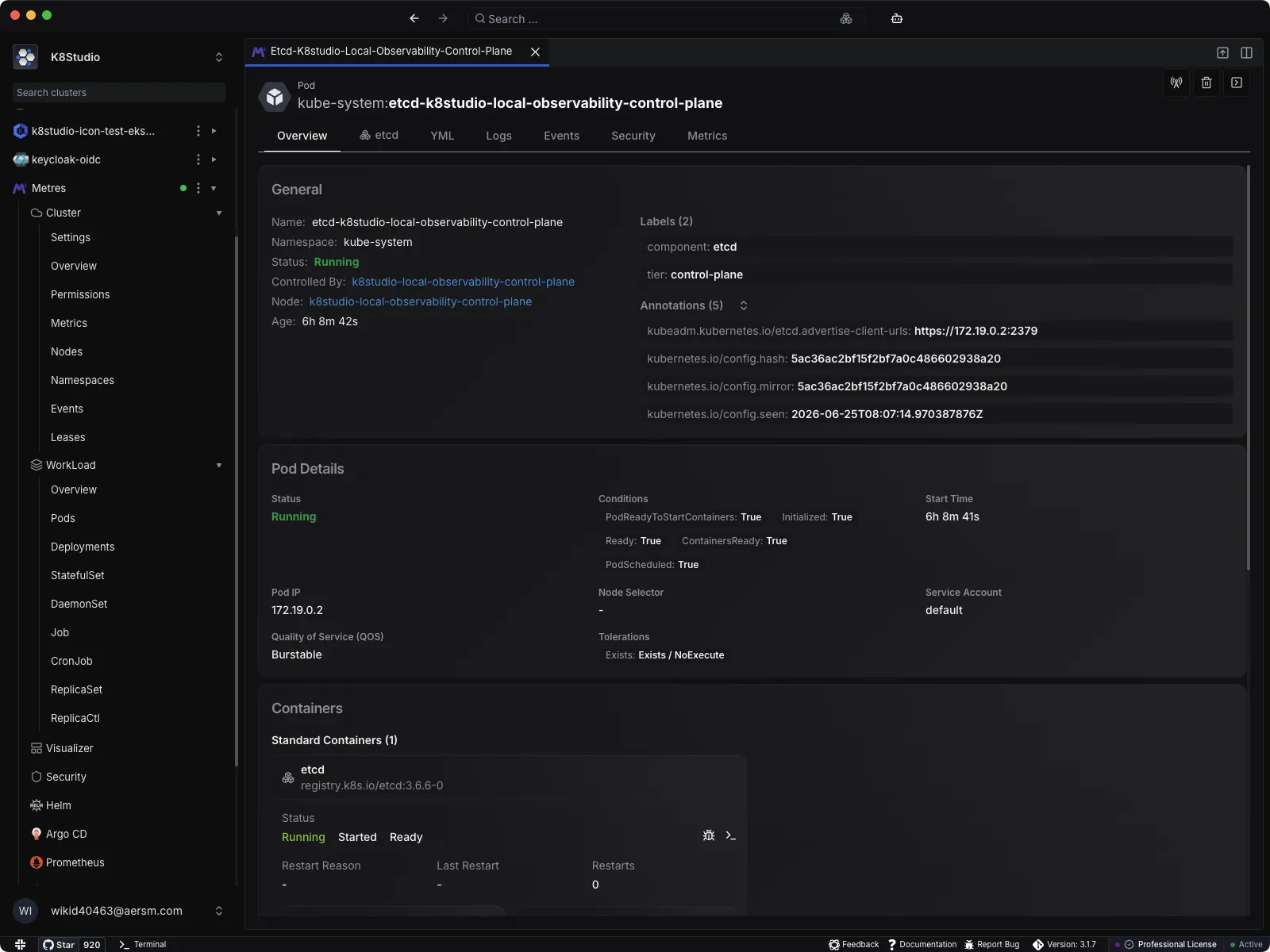
Pods, Deployments, Services, CRDs, Gateway API, RBAC, and more.
A live map of namespaces, workloads, services, routes, and dependencies.
Object relationships from any selected Kubernetes resource.
Cluster events grouped by resource and time.
Live logs, aggregated workload logs, and shell access in context.
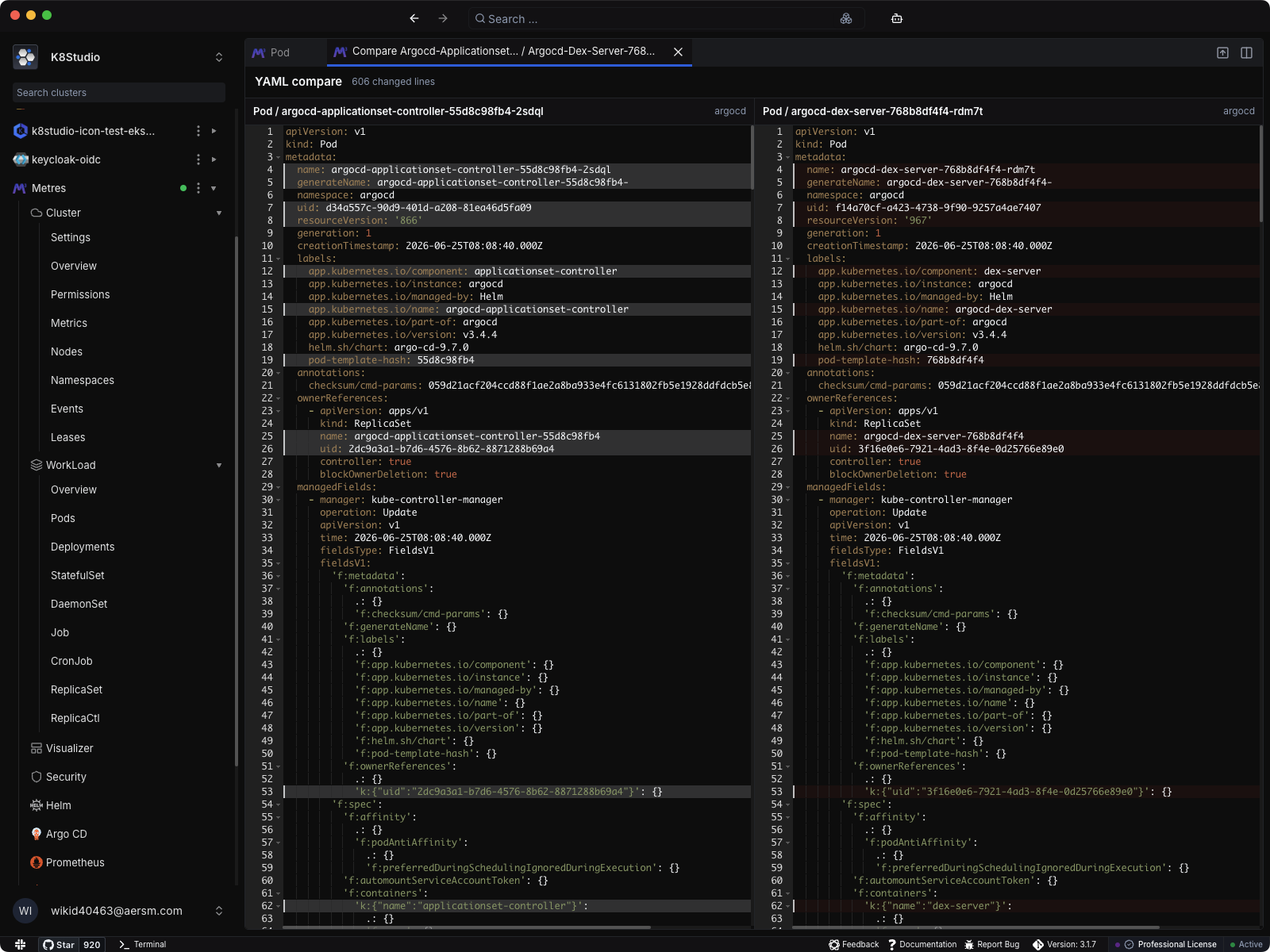
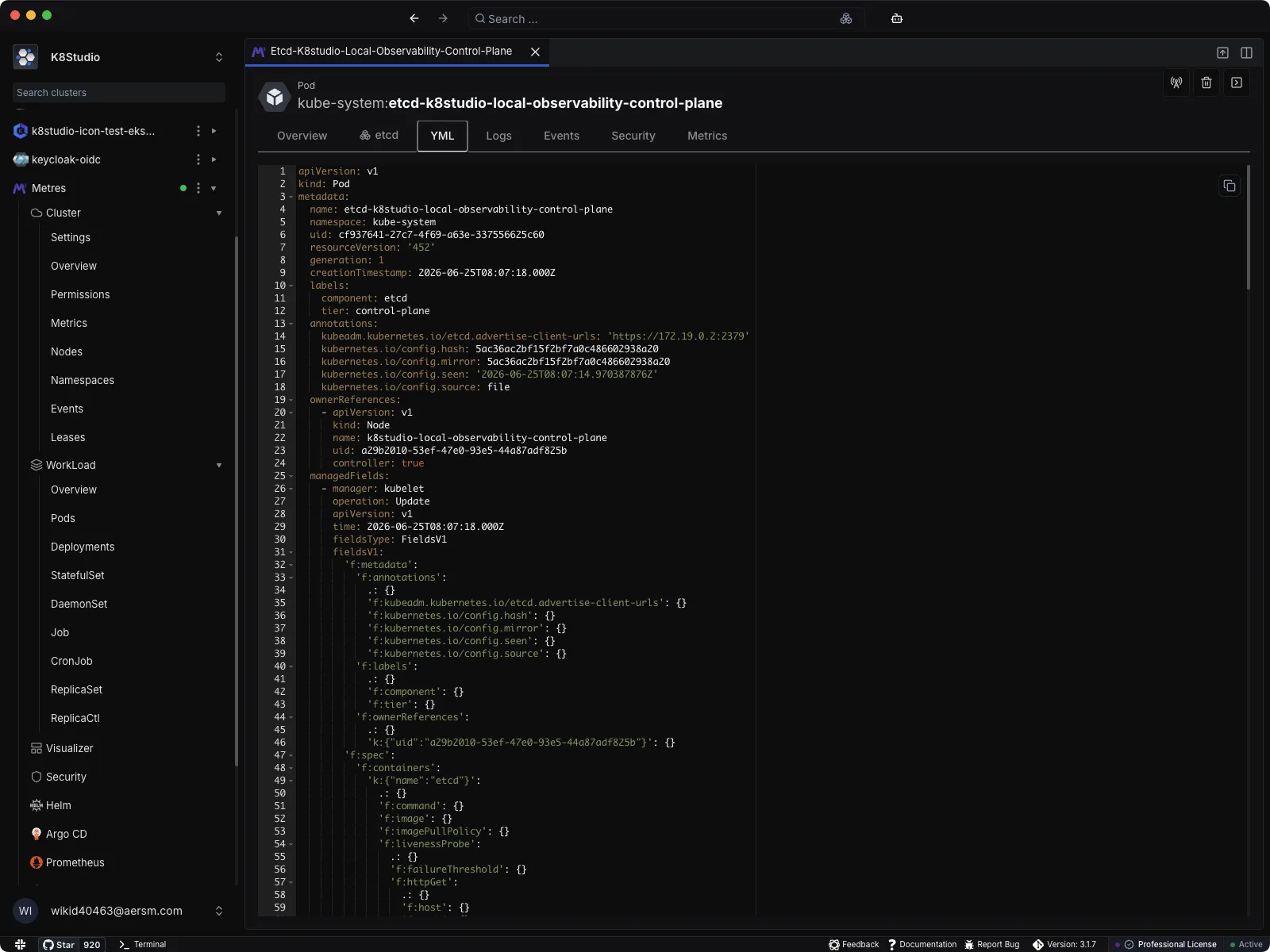
Inspect, edit, compare, and review manifests without leaving the workspace.
Manage releases, permissions, roles, bindings, and service accounts visually.
CloudMaps Beta
CloudMaps turns your cluster into a spatial model of namespaces, workloads, pods, services, routes, storage, policies, and dependencies. See the structure, follow relationships, and spot problems faster than a tree or table can show them.
Included in the 15-day Professional trial, Professional, and Professional Airtight. Not included in Basic after the trial.
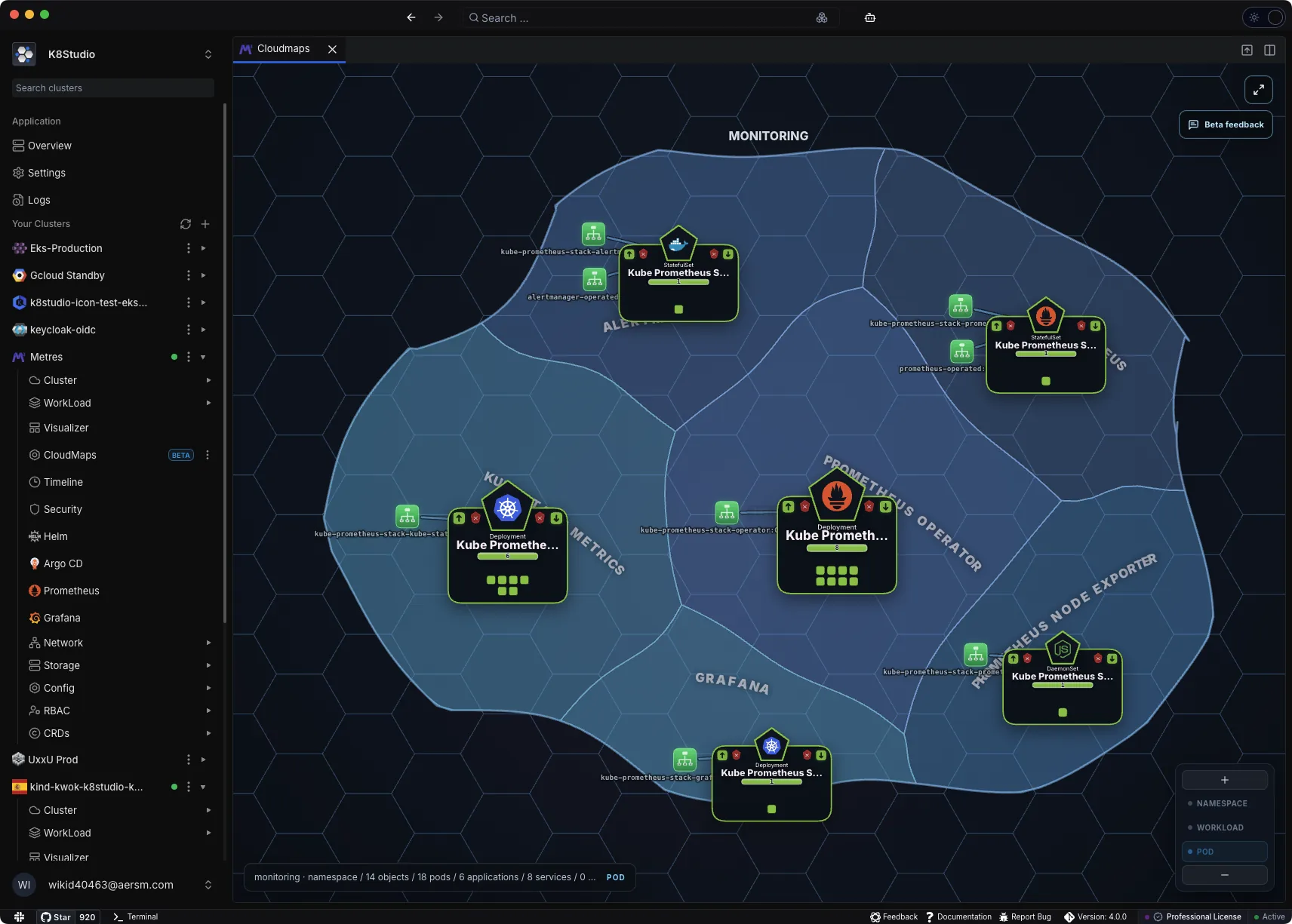
Move from the whole cluster into regions, namespaces, workloads, pods, routes, and dependencies without losing orientation.
Namespaces stay as islands, workloads own their pods, and regions group related platform and application areas.
Follow Services, Gateway API routes, storage, policies, nodes, ports, and object dependencies in context.
Designed for clusters with 5,000+ workloads by showing the right level of detail as you zoom.
Understand what a workload can reach, what depends on it, and which changes could affect nearby resources.
Every other serious Kubernetes management platform - Komodor, Groundcover, Devtron, Lens Prism - requires you to install a DaemonSet, sidecar, or Operator into your cluster. That software runs persistently, holds cluster-level RBAC permissions, and sends data to the vendor's cloud.
K8Studio installs nothing. It connects to your Kubernetes API server via kubeconfig - exactly like kubectl - and core cluster processing happens locally on your machine. Licensing and update checks use K8Studio services, and remote AI runs only when you configure and invoke a provider. Professional Airtight supports the fully offline workflow.
This is not a feature we added. It's a foundational architecture decision that affects your security posture, compliance burden, and what happens when a vendor goes down.
GitOps + observability
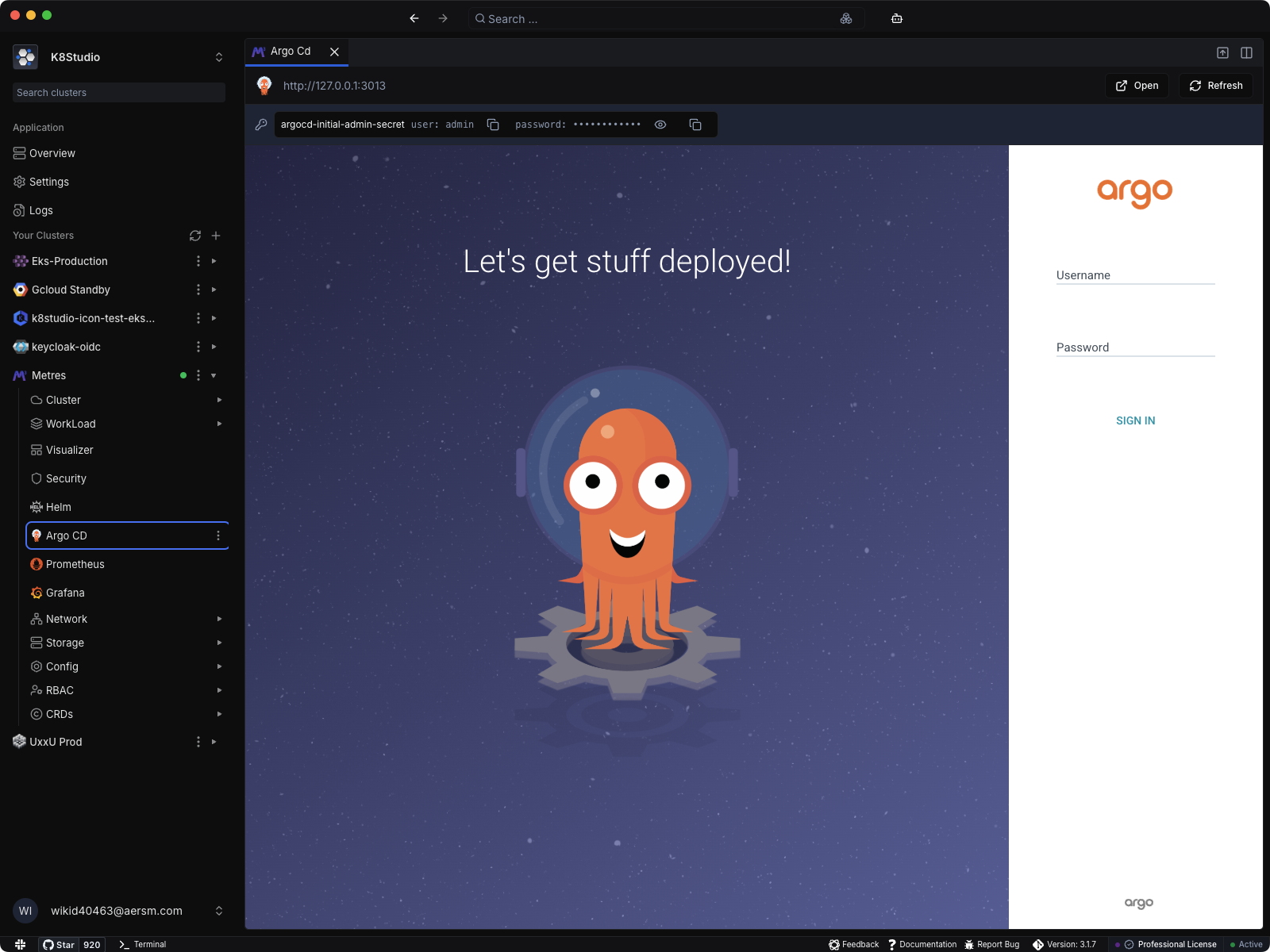
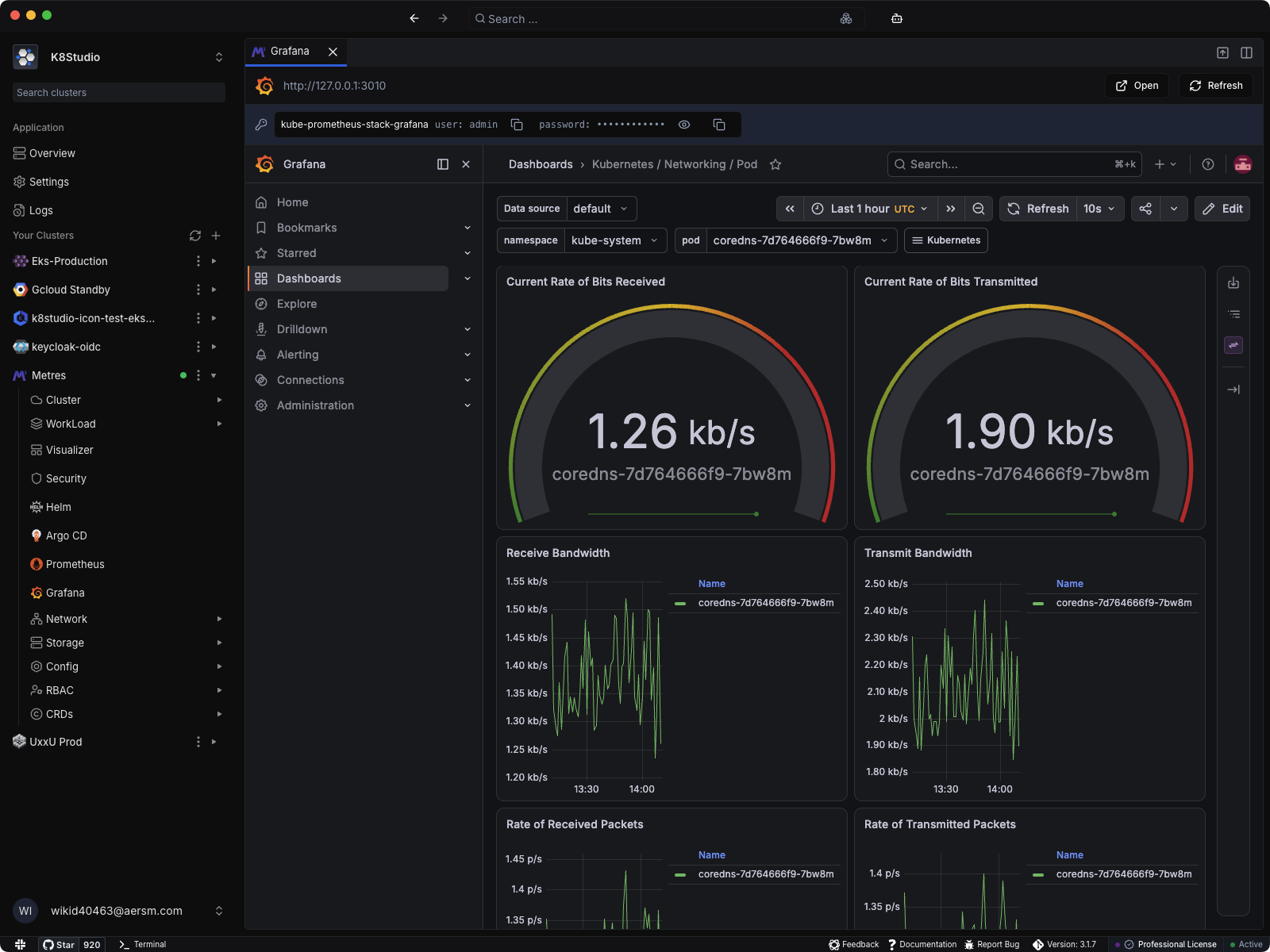
K8Studio brings GitOps and observability into the same agent-free window. See your ArgoCD applications, Grafana dashboards, and Prometheus metrics alongside your clusters - no context-switching, no extra agents, no data leaving your machine.
ArgoCD · Grafana · Prometheus · Helm
The integrations that turn a Kubernetes viewer into a Kubernetes IDE.
AI assistance for Kubernetes
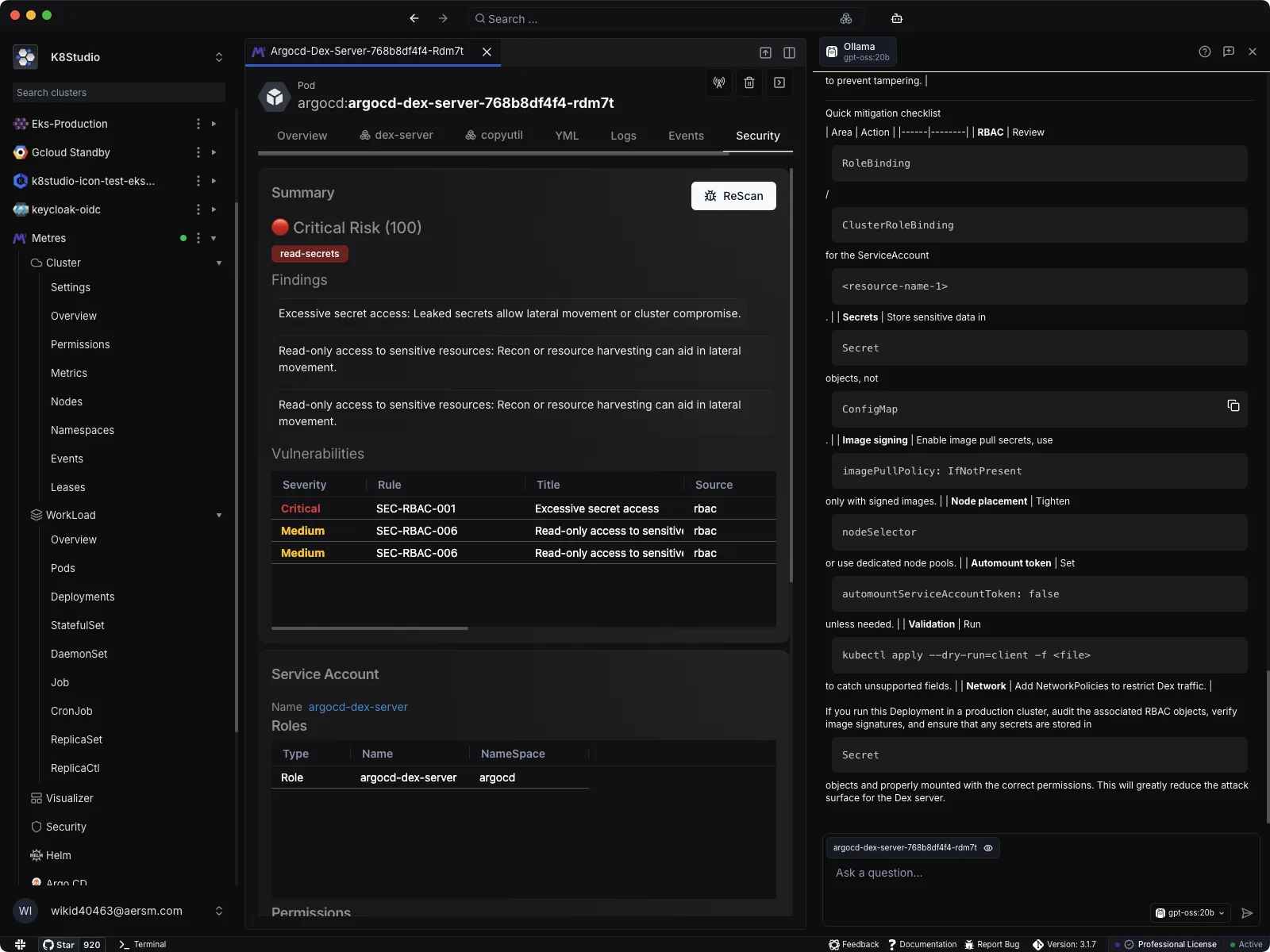
K8Studio Copilot is not a generic chat box. It is connected to the app context, can reason over selected resources, and can use K8Studio MCP tools to inspect, navigate, diagnose, and prepare reviewed Kubernetes changes while giving teams stronger privacy controls around what reaches a model.
Copilot can use the selected cluster, namespace, workload, YAML, events, logs, and visible K8Studio context.
K8Studio MCP gives Copilot structured tools to open pages, inspect resources, analyze issues, and prepare changes.
Mutating actions go through K8Studio confirmation, RBAC checks, and server-side dry-run preflight before apply.
K8Studio can anonymize sensitive cluster details before model use, and Ollama gives teams a local inference option when they want tighter data boundaries.
Ask for manifest reviews, rollout debugging, log analysis, resource explanations, and safer patch suggestions.
Use OpenAI models when you want strong general reasoning, Kubernetes troubleshooting, and fast hosted inference.
Use Anthropic Claude models for long-context analysis, careful explanations, and detailed operational reviews.
Use local Ollama models when you want the assistant to run on your machine or inside a restricted environment.
Different teams arrive from different tools. The reason they stay is the same: K8Studio keeps the desktop workflow local, adds the visual layer, and never asks your cluster to trust another agent.
Lens went commercial and now phones home. K8Studio keeps the desktop IDE experience - CloudMaps visualization, RBAC management, Helm releases, and multi-cluster support - without adding a cloud backend to your workflow.
Full Professional trial for 15 days. Then Basic from $9/mo or Professional with CloudMaps from $17/mo.
K9s is fast and we respect it. But once you need visual network paths, teammate-friendly onboarding, or a clearer way to inspect cluster relationships, a GUI stops being decoration and starts saving time.
K8Studio keeps keyboard-driven workflows while adding CloudMaps, logs, RBAC, and side-by-side cluster views.
Most Kubernetes tools get awkward the moment you mention offline networks, defense requirements, or strict procurement rules. K8Studio Professional Airtight was built for teams that cannot allow tools to call home.
Government, defense, healthcare, and finance teams can keep the same desktop workflow without punching holes in policy.
Enterprise cluster access
K8Studio follows your existing kubeconfig authentication flow - from simple certificates to enterprise SSO, AWS IAM, and OIDC providers. No shared passwords. No new IAM roles to create. No vendor credentials stored anywhere.
Already using OIDC, EKS exec, or kubelogin? K8Studio runs the same auth flow.
Modern Kubernetes auth is usually short-lived and delegated. K8Studio runs the configured auth flow, shows clear login states, and does not hide authentication failures behind a vendor relay.
Keycloak, Okta, Azure AD, Google Workspace, and other OpenID Connect providers.
EKS kubeconfigs that use aws eks get-token, including AWS IAM Identity Center sessions.
AAD-backed AKS clusters using kubelogin and exec credential plugins.
GKE clusters that use gke-gcloud-auth-plugin through kubeconfig exec auth.
Self-managed clusters and kubeadm kubeconfigs using certificate-based users.
Token-based kubeconfigs for automation, CI/CD, and in-cluster service accounts.
Any kubeconfig user that runs an external command to retrieve a short-lived token.
kubectl proxy, local API tunnels, and private endpoints exposed through localhost.
New SSO guides cover Keycloak OIDC, AWS IAM Identity Center with EKS, Google Cloud SSO with GKE, and Microsoft Entra ID with AKS kubelogin.
Straight answers about K8Studio's agent-free architecture, air-gapped support, pricing, and how it compares to Lens and K9s.
Covers
Local-first cluster access, offline use, pricing, and the switch path from Lens or K9s.
K8Studio is an agent-free desktop Kubernetes IDE. It connects through kubeconfig and brings CloudMaps™, RBAC, Helm, logs, metrics, AI Copilot, and multi-cluster workflows into one local workspace on macOS, Windows, and Linux.
Explore featuresYes. K8Studio talks to your cluster through the Kubernetes API, the same way kubectl does. No DaemonSet, sidecar, Operator, or CRD is installed. Core cluster processing stays local; licensing, updates, and remote AI connect only for the functions you use.
See the agent-free modelYes. If your workstation can reach the Kubernetes API server, K8Studio works in offline and air-gapped environments too. Professional Airtight is the option built for government, defense, healthcare, finance, and other controlled networks.
Read the air-gapped guideBoth are desktop Kubernetes IDEs, but K8Studio stays local and agent-free. It adds CloudMaps™, built-in RBAC, and offline-ready workflows without requiring a vendor cloud backend for advanced use.
Compare with LensK8Studio is built for engineers who want K9s speed plus a visual layer. You keep keyboard-friendly workflows and gain CloudMaps™, logs, RBAC, an integrated terminal, and multi-tab cluster workspaces.
Compare with K9sK8Studio includes a full 15-day Professional trial with no credit card to start. Basic is $9/mo for core operations. Professional is $17/mo and includes CloudMaps, Timeline, Topology, AI, RBAC, and Helm. Professional Airtight is $187/yr for the same feature set with offline licensing.
View pricingTry every Professional feature free for 15 days. Then choose Basic from $9/mo or keep the full Professional workbench from $17/mo. Nothing installed in your cluster, ever.
Install the desktop app on macOS, Windows, or Linux and start with the same full-featured workspace on every machine.
Native desktop app · Full 15-day trial
Point K8Studio at your kubeconfig. It follows the auth flow you already use, without setup scripts, cluster agents, or extra permissions to grant.
Works with kubeconfig, exec auth, OIDC, EKS, AKS, and GKE
Use every Professional feature locally for 15 days. Then choose Basic from $9/mo for core operations or keep CloudMaps and the full workbench with Professional from $17/mo.
Nothing installed in your cluster, ever
Download
Available for macOS, Windows, and Linux.
Cluster access
K8Studio works with any kubeconfig-accessible cluster, including EKS, GKE, AKS, K3s, OpenShift, and private air-gapped setups.
Same auth flow. No agents. No cluster footprint.
Pricing path
15 days of Professional free. Then Basic from $9/mo or Professional from $17/mo. No credit card to start.
Used by 8,000+ DevOps engineers on macOS, Windows, and Linux. Works with EKS, GKE, AKS, K3s, OpenShift, and any kubeconfig-accessible cluster.
Contact
If you are evaluating K8Studio, working through Kubernetes access questions, or need help with licensing and restricted environments, send us a clear note and we will route it to the right person.
The most helpful messages usually mention your cluster environment, auth method, what you are trying to validate, and where you are blocked.
Ask about installation, licensing, trials, Kubernetes auth flows, offline environments, or feature fit.
Reach out if your team needs details about agent-free architecture, air-gapped use, or compliance-sensitive workflows.
Tell us what clusters, auth providers, or operational problems you want to validate with K8Studio.
Short messages are fine. If you already know the cluster type, auth provider, or the workflow you need to test, include it and we can respond with more concrete help.
Use the form below for product, support, licensing, and evaluation questions.